An idea whose time seems to have arrived is the use of stockpiled shipping containers as modular units for building homes. Because of the balance of trade in the United States, these hefty steel boxes are piling up in ports around the country and posing a storage problem. Several architects and builders are taking advantage of this surplus to recycle the containers.
According to David Cross of www.sgblocks.com, "a container has 8000 lbs of steel which takes 8000 kwh of energy to melt down and make new beams etc... Our process of modifying that entire 8000 lbs of steel into a "higher and better use" only takes 400 kwh of electrical energy (or 5%). Granted it takes a bit more "muscle" but we call this Value-Cycling which we feel is that next step up from Re-cycling." 
Each container measures 8 feet wide by 40 feet long by 9 feet tall. SG Blocks sells the finished structural systems (also called SG Blocks) for $9,000 to $11,000 per unit. The finished units have one or two walls removed and include the necessary support columns and beam enhancements.

According to KPFF Consulting, a structural engineering firm in St. Louis with extensive experience working with shipping containers, the units are stronger than conventional house framing because of their resistance to "lateral loads" -- those seen in hurricanes and earthquakes -- and because steel is basically welded to steel. The roof is strong enough to support the extra weight of a green roof — which has vegetation growing on it — if the owner should want it.

As for their energy efficiency, they claim that when the appropriate coatings are installed, the envelope reflects about 95 percent of outside radiation, resists the loss of interior heat, provides an excellent air infiltration barrier and does not allow water to migrate in.
One idea that has occurred to me is that this system might benefit from the use of SIP's (Structural Insulated Panels) for the roofs, rather that standard truss framing. SIP's are very well insulated, install quickly, and use much less wood than convention roofs.

Shipping containers are self-supporting with beams and stout, marine-grade plywood flooring already in place, thereby eliminating time and labor during the home-building process. Cross said construction costs are comparable to those in conventional building. Four to seven units are used in a typical home, he said.

Instead of nailing the siding they use "Super Therm", a ceramic paint made by Superior Products of Minnesota; it can be used as a paint, an adhesive, an insulator, a fireproofing material and an acoustic barrier. With this ceramic paint, they claim the insulation capacity is equal to a conventional house.

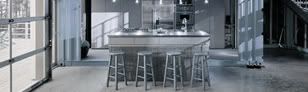
This finished house is virtually indistinguishable from conventional housing.

Adam Kalkin, of www.architectureandhygiene.com , has also become enamored with shipping containers as an architectural solution. The idea to do something with shipping containers came to Kalkin, a New Jersey resident, when driving to New York City, where he saw sky-high stacks of the unused cargo containers in the shipyards he passed. 
"The cargo containers, with a life span of about 20 years when used for their original purpose, have an “infinite life span” when stationary and properly maintained," Kalkin says. “To me they are like a treasured antique: they may not be inherently valuable, but the history and the storytelling add value.”

Environmentalists have embraced the design, applauding the recycling inherent to Kalkin's designs. And advocates for affordable-housing like the design, since according to Kalkin, "the total cost of a house—between $150,000 and $175,000 after the buyer settles upon the various options—works out to be between $73 and $90 per square foot, about half the cost of the conventional $200 per square foot for reasonable quality, new construction in the Northeast.”

Kalkin has recently opened a factory—“a hangar at a little airport in New Jersey”—to manufacture Quik Houses. “There are a lot of elbows flying in this process, and this is the best way to protect the quality of the house, to keep the accounting transparent, and to make sure I am not unwittingly responsible for heinous crimes to the built environment.” Once the factory is fully functional, Kalkin plans to export many of his products, commenting that “the possibilities of working on a world scale are exciting.”
Twenty-one thousand containers hit American shores every day of the year. Containers can be shipped to the interior of the country via trains and trucks. Shipping containers are like Lego toys and the modules can be assembled in thousands of ways.

In general it is a good thing to recycle materials that otherwise have no further use for their intended purpose, and this is true here. As for whether one can make a comfortable house out of these metal boxes, the biggest question is: insulation...it is essential, but there are many ways to insulate these containers, so this is not a big concern. Another concern that many people would have is whether a metal box would have adverse health effects because of EMF (electro-magnetic frequencies) generation or propagation. Some people are sensitive to these while others are not.
There is no doubt that these containers can be used to fabricate very strong shells that would withstand substantial abuse from the ravages of nature.