Showing posts with label lot ek. Show all posts
Showing posts with label lot ek. Show all posts
Lafayette Tower, NYC
87 lafayette street,
city realty posting engine 31 firehouse,
hybrid,
lafayette tower,
lot ek,
New York City,
young woo and associates


Lafayette Tower A Beautiful Building You May Never See
Those of you who salivate at LOT-EK’s amazing shipping container structures may be wondering whatever happened to the proposed Lafayette Street Tower near New York City’s Chinatown. The building, which received much press last year, was commissioned by Mr. Woo of Young Woo & Associates, who (like me) was intrigued by the design firm’s use of recycled containers in both residential and commercial buildings.
Partially inspired by the industrial feel of the neighborhood, the 19-story tower was slated to be erected at 87 Lafayette Street, adjacent to the city’s former Engine 31 firehouse. The innovative shape was to slant to the north as it grew upward and would utilize shipping containers that protruded from the front in varying degrees. A City Realty posting last year said the base of the building was to be “clad in gunmetal glazed terracotta while the setback tower” was to employ brush stainless steel that would showcase “organic curves while reflecting the area’s industrial past.”
According to LOT-EK, the tower was “a hybrid construction combining a simple concrete slab construction clad in glazing” and “a second skin constructed from a metal mesh” that would provide privacy from the outside while filtering the sun’s rays. “The interstitial spaces between the mesh and glazing, created by a scaffolding-like steel skeleton,” were to “function as semi-private balconies” – which, from the looks of them, would have provided incredible visual access to the bustling city below.
A 3-D effect would be added by the shipping containers, which would feature bathrooms, kitchens and leisure spaces, while an array of solar panels would line the building’s roof.
So, what happened to this amazing structure? A representative from LOT-EK (pronounced “low-tech”), who was kind enough to respond to my query, said it “has been stuck in the city’s building approval process” and at this time is not scheduled to move forward – a regrettably backwards ending to a forward thinking design that could have created new architectural ground and provided a stand-out aesthetic to a visually diverse historic neighborhood.
Here’s to hoping things change for the Lafayette Tower. Just not the design…
Puma City
building code,
hvac system,
il mostro,
lot ek,
mobile store,
night club,
puma city,
puma container city,
sail boat
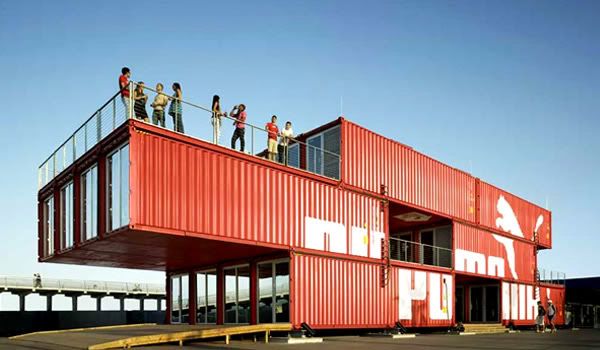
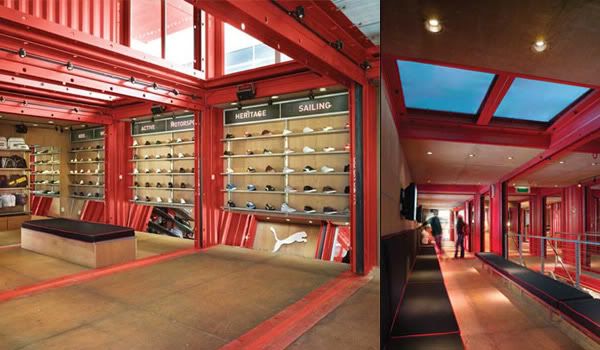
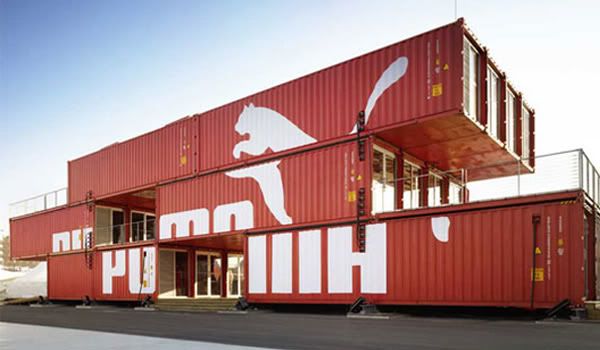
Puma City Shipping Container Super Store Designed For Travel
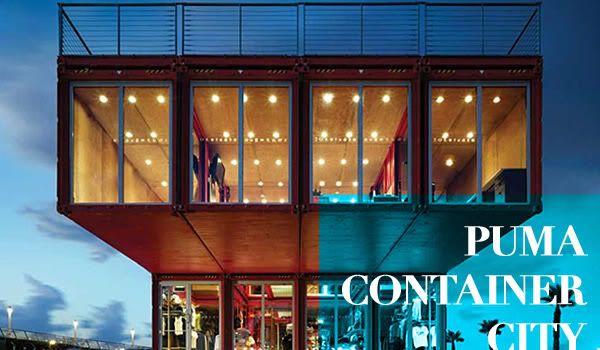
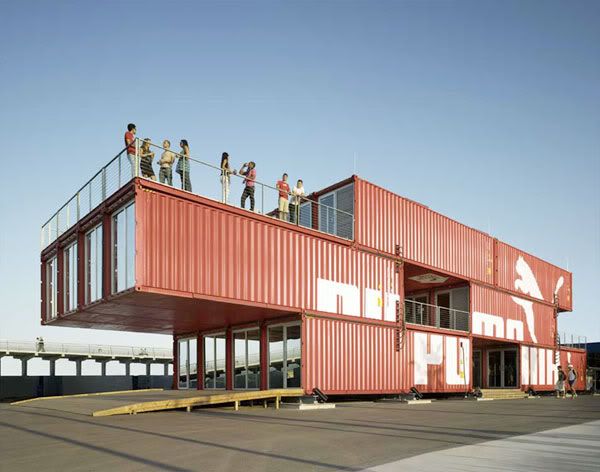
Taking portable buildings to the extreme, Puma (the shoe company) hired the Architecture firm Lot-Ek to design a 11,000 square feet mobile store, which they would send around the world on a cargo ship, accompanied by some Puma Sail boats.

Lot-Ek took 24 standard shipping containers, retrofitted and transformed them into what they are calling Puma City. The building was even built with international travel in mind, meeting international building codes, dramatic climate changes, plug-in electrical and HVAC systems and ease of assembly. This industrial tri-level super store, has an open design, with built in shelving, recessed lighting, large expansive outdoor decks and seems perfectly suited as a night club.
Treehugger : Puma City is a truly experimental building that takes full advantage of the global shipping network already in place. At 11,000 square feet of space, it is the first container building of its scale to be truly mobile, designed to respond to all of the architectural challenges of a building of its kind, including international building code, dramatic climate changes, plug-in electrical and HVAC systems and ease of assembly and operations.

Ecosistema Urbano : Twenty-four shipping containers are retrofitted and transformed into PUMA CITY, a transportable retail and event building that is traveling around the world along with the 70-foot long Puma sailing boat – il Mostro – during the one-year long 2008 Volvo Ocean Race, just started in Alicante, Spain in early October. The building is fully dismountable and travels on a cargo ship along with the sail boats; it will be assembled and disassembled a number of times once it reaches the different international harbors.
History on Container Housing
adele,
container city,
Daniel Noiseux,
history on container housing,
idekit,
lot ek,
maritime,
Montreal,
movbox,
puma city,
quai des eclusiers,
urban designer
Brief History of Shipping Container Housing Projects


The idea of making buildings out of old maritime shipping containers - those long, narrow steel boxes used to ship bulky items by sea and truck - is not new.
But a couple of Montreal-area companies are now offering prefabricated shipping container kits that promise to make building a home or business cheaper, faster and more environmentally friendly.
Over the past 15 years or so, green-minded architects and urban designers have been dreaming up creative new uses for the millions of used shipping containers that are taking up space in shipyards and dumps around the world.
Shipping container projects around the world include designer homes, a youth hostel in Amsterdam, a large-scale residential development in London called Container City and a travelling retail store. (The latter, designed by New York City architecture firm LOT-EK for the sportswear company Puma is an 11,000-square-foot retail outlet made of 24 refurbished containers.)
These watertight, durable, corrugated steel containers are great for transporting large items by ship and truck, but after a few decades their travelling days are over. Though some old containers are too damaged to pass inspection, many remain intact but companies find it cheaper to buy new containers than to ship empty ones back to their point of origin, which has lead to a surplus.
The containers are rust-proof, fireproof and mould-proof - measuring about 6 metres long and 2.5 metres in height and width - making them well-suited for re-use as buildings. And since they are so abundant, they are relatively cheap and easy to acquire.
Montreal entrepreneur Daniel Noiseux has just opened a mobile restaurant - a transformed and refurbished container - on the Quai des éclusiers in the Old Port. Noiseux calls his prototype the MuvBox, and is marketing the concept to entrepreneurs who like the idea of not being tied down permanently to any one location.
Except for an eye-pleasing paint job, the MuvBox looks like a shipping container when closed. But within minutes every morning, it is transformed into a small open-air diner, complete with tables on a terasse, awnings for shade and a fully functional kitchen. Solar panels on the roof provide 30 to 40 per cent of the energy needs.
It's all in the box, Noiseux says.
"We think of the MuvBox as a boat that you can anchor anywhere, that is totally self-contained and self-sufficient, and when it leaves a place, there is no trace of its presence left behind," said Noiseux, who also owns the Pizzaiolle restaurant chain.
Although his first prototype is a restaurant, Noiseux said he can tailor the concept to a client's needs. The MuvBox could be a travelling retail outlet, bistro or demonstration unit. The base price of a MuvBox, which includes transformation of the container, lighting, flooring, and exterior design, is $150,000.
And in Ste. Adèle, a company called Idekit Homes is offering to turn one or more shipping containers into fully insulated, functional homes or home extensions at a cost of about $100 per square foot.
Jocelyne Labelle and her partner Bernard Morin completed and moved into their first prototype of an Idekit home in 2007. The three-bedroom, 3,000 square-foot home is made from seven shipping containers. The steel containers' corrugated steel walls are covered with soy-based urethane insulation, and finished in wood.